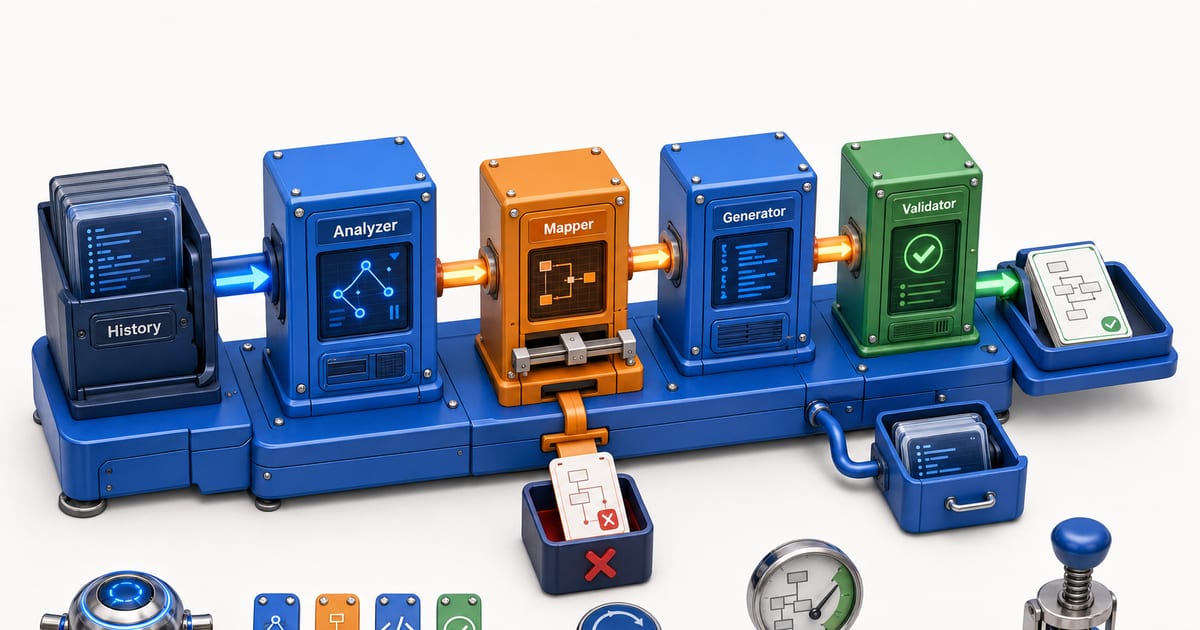
The first version of this orchestration failed in a very specific way: the mapper kept producing templates that looked plausible to a human and were wrong for the platform. The failure was not that the model could not reason. What I had built was one broad conversation carrying too many jobs at once, so a wrong structure got accepted early and then rode all the way to the end. By the time the validator complained, the chain had already lost the distinction between analysis, mapping, generation, and approval.
So I stopped treating the system like a prompt stack and started treating it like a state machine. In the workflow analyzer SaaS, runner/azure_foundry/src/orchestrator.py does the important work. It creates the kernel, registers the plugins, assembles the agents, defines who speaks next, and decides when the run is done. Wrapped around that orchestration is the state manager in runner/azure_foundry/src/state_manager.py, which lets a run resume from the last durable message history instead of inventing a fresh conversation every time. One design choice, and the behavior of the whole pipeline changed.
The architecture I wanted was easy to describe and annoying to get right. Each agent gets one contract. Each contract produces one kind of output. The validator is the gate that decides whether that output can move forward. The analyzer looks at the workflow analysis and identifies automation opportunity. The mapper turns that opportunity into abstract integration steps. The generator turns the mapped steps into a platform-shaped template. And the validator checks the structure, then either approves the run or sends it back to the generator.
Splitting the roles was part of what made this work. The other part was making the next speaker explicit, which is what AgentGroupChat gives me here: a selection strategy, a termination strategy, and a history buffer that can be rehydrated before the chat starts. With those pieces in place, the system stops behaving like a free-form exchange and starts behaving like a controlled pipeline.
What broke first
The first architecture looked tidy on paper and failed under repetition. I had an analysis step, a mapping step, a generation step, and a validation step, but the conversation around them was too loose. The mapper started inventing platform syntax because nothing in the orchestration made that impossible. The generator then built on top of that invented syntax. The validator only saw the problem after the wrong shape had already been repeated several times.
Retries were worse. If the run timed out or the validator rejected the output, the next attempt often lost the conversation history that explained why the output had failed, so the system retried from a weak starting point and repeated the same mistake. What it needed was not more creativity. It needed a strict memory of what had already happened, plus a strict rule about which agent was allowed to correct which class of mistake.
Hence the narrow contract chain with validator-led convergence. The validator does not try to repair everything. It does one job: decide whether the generated template is acceptable. No, and the generator gets another pass. Yes, and the run terminates. Correction stays local instead of every agent piling into every mistake.
The core cycle in AgentGroupChat
The orchestration in runner/azure_foundry/src/orchestrator.py is built around AgentGroupChat with two strategies attached: a selection strategy that decides the next speaker, and a termination strategy that decides when to stop. That pairing is the heart of the pattern.
The selection strategy reads the conversation history and follows a fixed pipeline:
- Analyzer speaks first.
- Mapper speaks second.
- Generator speaks third.
- Validator speaks fourth.
- If the validator returns INVALID, the next speaker is the Generator again.
- If the validator returns WORKFLOW_APPROVED, the chat ends.
Compare that to a single model answering everything inside one giant instruction block. Different shape entirely. The selection strategy makes the pipeline visible to the runtime, and it gives me somewhere to encode the retry rule explicitly instead of hiding it inside a paragraph of instructions.
The termination strategy carries just as much weight. The validator is the only agent whose result can end the run, and the run still has a maximum iteration cap of 10 so a bad cycle cannot spin forever. That cap earns its place because agent cycles do not usually fail in dramatic ways. They fail by wobbling. Repeat a small wobble enough times and you get wasted tokens, delayed jobs, and outputs that never settle.
Here is the shape of that control flow in a standalone Python example that mirrors the same idea. It does not depend on Azure or Semantic Kernel, but it shows the exact contract I want the orchestrator to enforce:
from dataclasses import dataclass
from enum import Enum
from typing import Any, Dict, List, Optional


class AgentName(str, Enum):
    ANALYZER = 'Analyzer'
    MAPPER = 'Mapper'
    GENERATOR = 'Generator'
    VALIDATOR = 'Validator'


@dataclass
class Message:
    role: str
    content: str
    name: Optional[str] = None


def rehydrate_history(history_state: List[Dict[str, Any]]) -> List[Message]:
    return [
        Message(
            role=item.get('role', 'user'),
            content=item.get('content', ''),
            name=item.get('name')
        )
        for item in history_state
    ]


def next_speaker(history: List[Message]) -> Optional[AgentName]:
    if not history:
        return AgentName.ANALYZER

    last = history[-1]
    if last.role == AgentName.VALIDATOR.value:
        if 'WORKFLOW_APPROVED' in last.content:
            return None
        if 'INVALID' in last.content:
            return AgentName.GENERATOR

    order = [AgentName.ANALYZER, AgentName.MAPPER, AgentName.GENERATOR, AgentName.VALIDATOR]
    seen = [msg.role for msg in history if msg.role in {agent.value for agent in order}]
    if not seen:
        return AgentName.ANALYZER

    last_agent = AgentName(seen[-1])
    idx = order.index(last_agent)
    return order[min(idx + 1, len(order) - 1)]


if __name__ == '__main__':
    restored = rehydrate_history([
        {'role': 'Analyzer', 'content': 'Detected CRM handoff', 'name': 'Analyzer'},
        {'role': 'Mapper', 'content': 'Trigger + action pair identified', 'name': 'Mapper'},
        {'role': 'Generator', 'content': '{"triggers": [], "actions": []}', 'name': 'Generator'},
        {'role': 'Validator', 'content': 'INVALID: missing triggers and actions', 'name': 'Validator'},
    ])
    print(next_speaker(restored))
Small as it is, that example captures the behavior I care about most: the validator does not restart the chain, and the chain does not forget where it left off. If the validator rejects the output, the next speaker is the Generator, not the Analyzer, because the analysis step already did its job.
How history gets rehydrated before the run
Resumability matters here because the orchestration runs inside Prompt Flow, not inside a single in-memory toy conversation. In the real flow, state_manager.py loads the prior session history before the orchestrator node runs. That history arrives as history_state, and the orchestrator reconstructs ChatMessageContent objects from each saved message so AgentGroupChat can continue the conversation instead of starting over.
Easy detail to miss. Expensive one to ignore. Without rehydration, every timeout becomes a reset. With it, the system can pick up from the last durable state and keep going. If the validator has already rejected a malformed template, that rejection stays in history. If the mapper already established the target platform and the apps involved, that context is still available. If the previous run ended halfway through generation, the next run does not have to relearn the same facts.
The lifecycle is straightforward:
- load session history from
state_manager.py - reconstitute the saved messages into the chat history
- run the orchestrator with the restored history
- persist the resulting execution state after the run
Durability comes from exactly that. The system continues the same conversation under the same constraints, rather than pretending the previous attempt never happened.
The template library earns its keep
The template library in runner/template_library hands the generator a starting point that already matches the platform family. The generator should not be inventing a whole import shape from memory. It should be filling a known skeleton with detected apps, triggers, and actions.
Starting from a template base, the generator can spend its effort on the parts that actually need reasoning: mapping the workflow into the right platform structure, inserting the right application names, filling the right fields. The library keeps it from wandering into a malformed top-level structure.
Which is also why the validator can stay narrow. If the generator is working from a known shape, the validator does not need to be a general-purpose critic. The validator only has to check the contract that matters for the chosen platform: do the expected keys exist, is the structure complete, and does the result satisfy the platform rules well enough to be accepted?
Every piece leans on the others. The template library constrains the starting point, the generator fills it, the validator checks it, and the selection strategy decides whether the system should move forward or send the work back to the generator.
The real runtime wiring in the orchestrator
The orchestrator itself is where the system becomes code-first instead of prompt-first. The kernel gets initialized with Azure OpenAI configuration from the environment, the validation plugin is registered, and the template library plugin is registered, all before the conversation begins. Then the agents are assembled and the selection and termination strategies are attached.
Ordering is not incidental here. The model cannot speak before the kernel has its service. The generator cannot rely on the template library unless the plugin is present. The validator cannot enforce the schema unless the validation plugin is loaded. Writing the orchestration as code makes those dependencies explicit, where a prose prompt would leave them implicit.
The runtime wiring also keeps the Azure configuration outside the orchestration logic itself. The environment supplies the deployment name, endpoint, and API key, and the kernel uses those values when it constructs the Azure chat completion service. Orchestration stays focused on behavior rather than connection plumbing.
In practice, the structure looks like this:
The important arrow is the one that returns from Validator to Generator. That is the local correction path. Invalid output does not reset the analysis, erase the mapping, or jump back to the start. It goes back to the one agent responsible for producing the template.
A runnable validator that actually checks structure
The validator must reject malformed output or it is just another polite participant in the conversation. Here is a minimal, runnable version that checks a template shape and returns a real verdict:
import json
from typing import Any, Dict, List


SUPPORTED_PLATFORMS = {'zapier', 'make', 'n8n'}


def select_template(platform: str) -> Dict[str, Any]:
    platform_key = platform.lower()
    if platform_key not in SUPPORTED_PLATFORMS:
        raise ValueError(f'Unsupported platform: {platform}')

    base = {
        'name': f'{platform_key}_automation',
        'triggers': [],
        'actions': [],
    }
    return json.loads(json.dumps(base))


def validate_template(template_json: str, platform: str) -> Dict[str, Any]:
    errors: List[str] = []

    try:
        template = json.loads(template_json)
    except json.JSONDecodeError as exc:
        return {'status': 'invalid', 'errors': [f'Invalid JSON: {exc}']}

    for key in ('name', 'triggers', 'actions'):
        if key not in template:
            errors.append(f'Missing key: {key}')

    if platform.lower() not in SUPPORTED_PLATFORMS:
        errors.append(f'Unsupported platform: {platform}')

    if not isinstance(template.get('triggers'), list) or not template.get('triggers'):
        errors.append('At least one trigger is required')

    if not isinstance(template.get('actions'), list) or not template.get('actions'):
        errors.append('At least one action is required')

    return {
        'status': 'valid' if not errors else 'invalid',
        'errors': errors,
    }


if __name__ == '__main__':
    bad = json.dumps({'name': 'demo', 'triggers': [], 'actions': []})
    good = json.dumps({'name': 'demo', 'triggers': ['new_event'], 'actions': ['create_record']})
    print(validate_template(bad, 'Zapier'))
    print(validate_template(good, 'Zapier'))
That is the behavior I want the real validator path to approximate: reject missing structure, reject empty structure, and hand back a verdict the selection strategy can use to decide the next speaker. The exact shape of this standalone example matters far less than the discipline behind it. Validation is not a suggestion. It is a gate.
Why this pattern is easier to trust
This design works because every failure has one owner. Weak analysis, and the Analyzer is the problem. Invented structure in the mapping, and the Mapper is the problem. A template that does not fit the platform, and the Generator is the problem. A template that violates the contract, and the Validator says so. Debugging gets much easier when I am not trying to infer which layer went wrong from a cloud of blended instructions.
The retry logic gets saner too. When the validator rejects the output, I do not want the entire conversation to restart. I want the generator to take another pass with the same context still in memory, and that is what the selection strategy enforces: the orchestrator reads the last message, sees the invalid verdict, and routes execution back to the generator. Nobody else has to renegotiate the earlier steps.
State rehydration matters here because a retry is a different animal from a fresh run. A fresh run throws away the exact information I need most: what failed, what was already agreed, and which platform shape was already chosen. Rehydration preserves that state so the next attempt can repair the actual fault instead of replaying the whole conversation.
What comes out of it is a system that can fail locally without collapsing globally. Sounds like a small thing until you watch a long run survive a rejection, recover from persisted history, and land on a valid template without re-deriving the entire workflow from scratch.
What actually settled it
Using multiple agents is not the strongest part of this orchestration. What settled things was the constraint: agents bounded by code, the next speaker chosen by strategy, the validator owning the final gate, and session history that survives retries. Once those pieces were in place, the mapper stopped wandering and the generator stopped improvising against the wrong shape.
That gave me exactly what I wanted from the workflow analyzer SaaS: a chain that can analyze, map, generate, validate, and resume without pretending a failed attempt never happened. Next I am interested in pushing more of the template shape into the library itself, so the generator begins with an even tighter platform skeleton and the validator has less to reject in the first place.