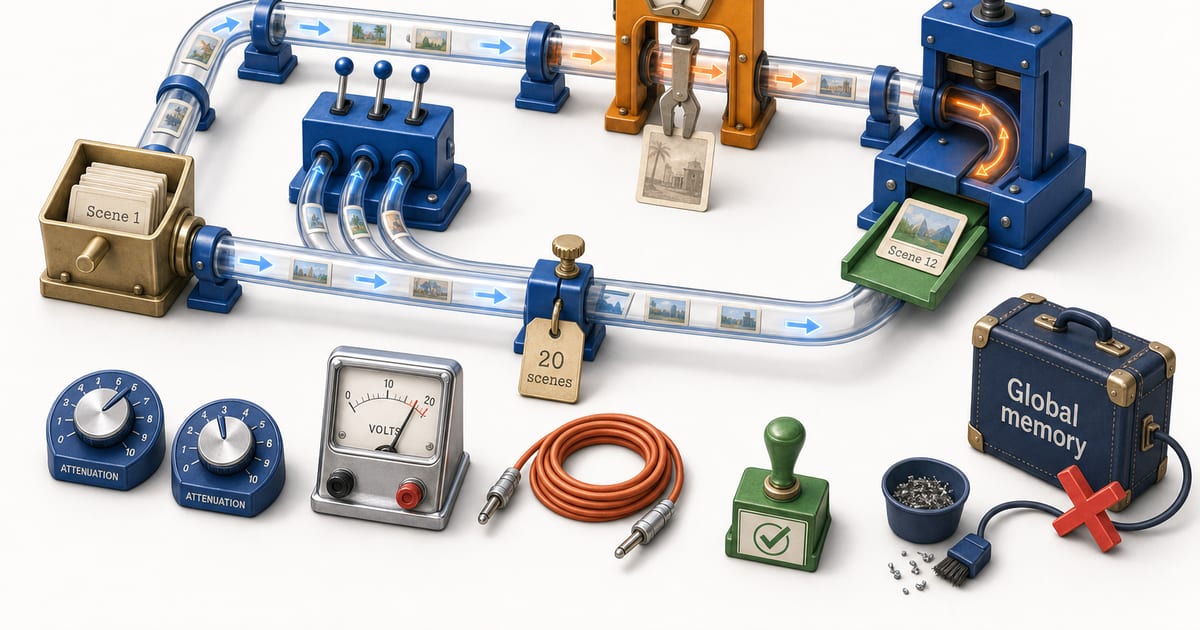
On a long chain, Scene 12 came out plausible. It just no longer felt like it belonged to Scene 1. Nothing was "broken" in any single step. The damage was death by a thousand cuts: each transition slightly off, and those slight offs multiplied.
So I stopped treating consistency as a global memory problem.
In Scenematic, I treat it like propagation through a circuit. You don't carry the whole circuit state inside each component. You push constraints along edges, attenuate them with distance, re-anchor periodically so noise doesn't accumulate, then close the circuit by measuring outputs and applying targeted corrections.
The closed circuit has three modules:
- Constraint propagation decides what must be preserved as you move through the scene graph.
- Hierarchical scene bridge measures what was preserved and turns it into a concrete transition plan.
- Progressive pipeline fixes what wasn't preserved, using diagnosis instead of blind retries.
The core insight is simple and annoyingly effective:
Long-form video consistency isn't a memory problem. It's local propagation with periodic re-anchoring.
When that holds, Scene 12 doesn't have to "remember" Scene 1. It only has to agree with Scene 11 under constraints that originated at Scene 1.
Key insight (early, because it's the whole game)
A naive chaining system asks every generation step to do an impossible job:
- preserve character identity
- preserve palette
- preserve camera language
- obey narrative intent
- introduce new content
…and do all of it from a single prompt plus a single similarity score.
That's how you get the classic failure: a candidate that scores well on one metric (say, embedding similarity) but breaks something humans notice immediately (palette, motion, composition).
My fix wasn't "more memory." It was a circuit:
- Propagation sets the target (what matters, how strongly, for how long).
- The bridge turns that target into generation parameters (strength plus prompt modifiers).
- The pipeline tests cheaply, measures what comes back, and corrects the weak ones.
Which is why Scene 12 can stay visually consistent with Scene 1 without carrying a global scratchpad.
How it works under the hood
The system is easiest to understand if you follow the data the way it actually flows: constraints → plan → exploration → scoring → corrections → retry → accept.
I like this shape because it keeps the responsibilities crisp:
- propagation answers "what must persist?"
- bridging answers "what should I do next?"
- the circuit answers "did it work, and if not, what exactly failed?"
1) Constraint propagation: BFS with attenuation + periodic refresh
The propagation module is the part that makes "no global memory" viable.
If you don't carry a full history, you still need some way for Scene 1's constraints (identity, palette, lighting) to influence Scene 12. So treat the project as a directed graph and push constraints forward along its edges.
Propagation is a BFS over the scene graph with three knobs that matter:
ATTENUATION_PER_STEP = 0.95(exponential decay)MAX_PROPAGATION_DEPTH = 5(don't let constraints haunt the whole project)REFRESH_INTERVAL = 5(periodically re-anchor so small errors don't compound)
Here's the real BFS core from my code:
const nextFrontier: string[] = []
for (const currentId of frontier) {
  const outEdges = graph.edges.filter(e => e.sourceId === currentId)
  for (const edge of outEdges) {
    if (visited.has(edge.targetId)) continue
    visited.add(edge.targetId)
    nextFrontier.push(edge.targetId)
    const needsRefresh = depth % REFRESH_INTERVAL === 0
    const effectiveDepth = needsRefresh ? 1 : depth
    const propagated: PropagatedConstraint[] = propagatable.map(c => ({
      sourceConstraint: c, sourceSceneId,
      propagationDepth: effectiveDepth,
      attenuationFactor: Math.pow(ATTENUATION_PER_STEP, effectiveDepth),
    }))
    result.set(edge.targetId, propagated)
  }
}
frontier = nextFrontier
depth++
The non-obvious part is effectiveDepth.
Without refresh, attenuation compounds forever, and Scene 1's constraints are basically vibes by the time you reach Scene 12. With refresh, every REFRESH_INTERVAL scenes I deliberately treat the constraint as if it were one hop old (effectiveDepth = 1). That's the re-anchor.
It isn't "remember Scene 1." It's "re-assert, on a schedule, what Scene 1 cares about."
Materialization: thresholds attenuate, enforcement can downgrade
Propagation produces PropagatedConstraint objects. Those aren't enforced directly. They have to become real SceneConstraints attached to the downstream scenes.
When I materialize, I do two important things:
- attenuate numeric thresholds using propagation depth
- downgrade enforcement to advisory if the constraint has decayed too far
Here's the real mapping logic:
export function materializePropagated(
  propagated: PropagatedConstraint[]
): SceneConstraint[] {
  return propagated.map(p => ({
    ...p.sourceConstraint,
    id: crypto.randomUUID(),
    threshold: p.sourceConstraint.threshold !== undefined
      ? attenuateThreshold(p.sourceConstraint.threshold, p.propagationDepth)
      : undefined,
    enforcement: p.attenuationFactor < 0.5 ? "advisory" as const : p.sourceConstraint.enforcement,
    metadata: {
      ...p.sourceConstraint.metadata,
      propagatedFrom: p.sourceSceneId,
      propagationDepth: p.propagationDepth,
      attenuationFactor: p.attenuationFactor,
    },
  }))
}
Two details matter in practice:
- The downgrade rule is explicit:
p.attenuationFactor < 0.5flips enforcement to advisory. - I persist the provenance in
metadata(propagatedFrom,propagationDepth,attenuationFactor) so the rest of the pipeline can explain why a constraint exists.
That downgrade is a pressure release valve. Keep everything "hard" forever and you end up fighting intentional story shifts. Let everything go soft immediately and the chain wanders. This rule gives the graph a spine rather than a straitjacket.
2) The scene bridge: turning "what matters" into a transition plan
Constraints sitting on a downstream scene aren't action yet. Something has to translate.
That's the scene bridge. It fuses three layers of features into a TransitionPlan, then derives two concrete outputs the generator can actually use:
recommendedStrength(an img2img strength in a bounded range)promptModifiers(short, explicit instructions)
The strength calculation is where a pile of competing forces gets compressed into a single knob.
Here's the real computeRecommendedStrength:
function computeRecommendedStrength(l1: L1Features, l2: L2Features, l3: L3Features): number {
  let strength = 0.85 - (l3.narrativeCoherence * 0.5)
  strength -= (l2.identityPreservation - 0.5) * 0.2
  if (l2.sceneShift === "high") strength += 0.1
  if (l2.sceneShift === "low") strength -= 0.1
  const motionVec = motionToVector(l1.motionContinuation)
  const hasMotion = Math.sqrt(motionVec[0] ** 2 + motionVec[1] ** 2) > 0.1
  if (hasMotion) strength -= 0.05
  return Math.max(0.30, Math.min(0.85, strength))
}
What I like about this function is that it's opinionated in exactly the way a generator needs:
- high narrative coherence pushes strength down (stay closer)
- high identity preservation pushes strength down (don't mutate faces)
- a "high" scene shift pushes strength up (allow change)
- motion continuity pushes strength down a bit (keep structure stable)
- the final clamp to
[0.30, 0.85]keeps the system out of pathological extremes
The limitation is just as obvious: it collapses a multi-dimensional plan into a scalar. Which is exactly why the prompt modifiers carry weight.
Prompt modifiers: small text, sharp intent
The bridge also produces modifiers that tell the generator, in plain words, what to preserve.
The part I rely on most is the preservation-priority switch, because it decides between "keep the face" and "keep the world":
case "character": modifiers.push("Focus on maintaining character identity, facial features, and clothing."); break
case "environment": modifiers.push("Focus on maintaining environment, spatial layout, and setting consistency."); break
case "mood": modifiers.push("Focus on maintaining mood, atmosphere, and tonal consistency."); break
This is one of those places where blunt beats clever. The model is going to hallucinate if you leave it room.
3) Progressive pipeline: diagnose, correct, and only then retry
Even with a good plan, generation is stochastic. So I don't pretend I'll nail it on the first attempt.
Instead, there are three stages:
- Stage 1 (Alignment): explore via think frames, pick a path, then run full generation
- Stage 2 (Refinement): if quality lands below the gate, identify the weak scores and apply targeted corrections
- Stage 3 (Recovery): last-resort fallback chain that prefers "consistent" over "creative"
Retrying isn't the interesting part. Retrying surgically is.
Diagnosis: turn weak scores into concrete actions
The function that makes refinement feel like engineering instead of gambling is diagnoseAndCorrect.
It takes:
signals: RewardSignalsplan: TransitionPlancurrentPrompt: stringthreshold = 0.5
…and returns a list of Correction objects.
Here's the real implementation:
export function diagnoseAndCorrect(
  signals: RewardSignals, plan: TransitionPlan, currentPrompt: string, threshold = 0.5
): Correction[] {
  const weakSignals = identifyWeakSignals(signals, threshold)
  const corrections: Correction[] = []
  for (const signal of weakSignals) {
    switch (signal) {
      case "colorHarmony":
        corrections.push({ signal: "colorHarmony", action: "inject_color",
          promptModifier: `Maintain exact color palette with dominant tone ${plan.colorTarget}. Use ${plan.brightnessZone} lighting.` })
        break
      case "compositionStability":
        corrections.push({ signal: "compositionStability", action: "reduce_strength",
          strengthAdjustment: -0.15 })
        break
      case "motionContinuity":
        corrections.push({ signal: "motionContinuity", action: "inject_motion",
          promptModifier: plan.motionContinuation !== "static camera"
            ? `Continue ${plan.motionContinuation} camera motion from previous scene.` : undefined })
        break
      case "visualDrift":
        corrections.push({ signal: "visualDrift", action: "increase_fidelity",
          strengthAdjustment: 0.10, promptModifier: "Preserve exact visual appearance from reference frame." })
        break
      case "narrativeCoherence":
        corrections.push({ signal: "narrativeCoherence", action: "rewrite_prompt",
          promptModifier: `Transitioning smoothly: ${plan.intendedChange}. Maintain visual continuity.` })
        break
    }
  }
  return corrections
}
Two things surprised me when I first wired this in:
- Lowering strength is my go-to fix for composition instability (
-0.15). That sounds backwards until you notice how often unstable composition is just the model taking too much freedom. - Color fixes want redundancy. The modifier repeats both palette and lighting, because the model will obey one and ignore the other unless you box it in.
The tradeoff is that corrections can fight each other. If visualDrift asks to increase fidelity (+0.10) while compositionStability asks to reduce strength (-0.15), you're negotiating. That's not a bug. That's multi-objective control being itself.
Stage gates: explicit thresholds
The progressive pipeline uses stage gates to decide whether to accept output or keep pushing:
- Stage 1 threshold:
0.70 - Stage 2 threshold:
0.60
I'm calling those out because they aren't magic defaults. They're the explicit gates that make the circuit closed. Without gates you don't have a control system. You have a hope system.
Recovery: the fallback chain that refuses to die
Stage 3 exists because real pipelines need a finish-the-job mode.
The recovery chain is intentionally conservative:
- try very low strength (
0.35) with an explicit "Preserve exact visual appearance..." instruction - fall back to the second-best think frame if it exists
- if all else fails, use the source frame as-is
Here's the real shape of that from my code:
async function stage3(
  sourceImageUrl: string,
  basePrompt: string,
  plan: TransitionPlan,
  thinkFrameResult: ThinkFrameResult | null,
  deps: PipelineDeps,
  config: PipelineConfig,
  sourceMotionDirection?: string
): Promise<{ imageUrl: string; signals: RewardSignals; compositeScore: number; attempts: number }> {
  // Strategy 1: very low strength to preserve source structure
  const recoveryUrl = await deps.generateFullQuality({
    sourceImageUrl,
    prompt: `${basePrompt} Preserve exact visual appearance and composition from reference frame.`,
    strength: 0.35,
    colorPalette: plan.colorTarget !== "#808080"
      ? { dominant: plan.colorTarget, palette: plan.colorPalette, description: "" }
      : undefined,
    motionDirection: sourceMotionDirection,
  })

  if (recoveryUrl) {
    const signals = await scoreKeyframe(sourceImageUrl, recoveryUrl, plan, deps.clipScorer, sourceMotionDirection)
    return {
      imageUrl: recoveryUrl,
      signals,
      compositeScore: computeCompositeScore(signals, config.weights),
      attempts: 1,
    }
  }

  // Strategy 2: second-best think frame
  if (thinkFrameResult && thinkFrameResult.scoredFrames.length > 1) {
    const secondBest = thinkFrameResult.scoredFrames[1]
    return {
      imageUrl: secondBest.candidate.imageUrl,
      signals: secondBest.signals,
      compositeScore: computeCompositeScore(secondBest.signals, config.weights),
      attempts: 0,
    }
  }

  // Strategy 3: source frame as-is (ultimate fallback)
  return {
    imageUrl: sourceImageUrl,
    signals: {
      visualDrift: 1.0,
      colorHarmony: 1.0,
      motionContinuity: 1.0,
      compositionStability: 1.0,
      narrativeCoherence: plan.narrativeCoherence,
    },
    compositeScore: 1.0,
    attempts: 0,
  }
}
I built this because long projects have a nasty failure mode: one scene that fails hard can poison everything downstream. Stage 3 is me choosing "plain but consistent" over "creative but broken," on purpose.
What went wrong (and why the re-anchor exists)
My first mental model was: if each scene is consistent with the previous one, the chain will stay consistent.
That's almost true, and it's exactly the kind of almost-true that ruins long-form generation.
Local consistency without re-anchoring behaves like a slow random walk. Even if each step is mostly correct, bias accumulates. The fix is encoded directly in propagation:
- attenuation keeps constraints from becoming immortal
- refresh keeps constraints from evaporating into noise
That REFRESH_INTERVAL = 5 isn't a performance hack. It's a control mechanism for the slow accumulation of error.
Nuances that make the circuit work in practice
A few design choices look small in code and matter a lot in behavior.
Advisory downgrade is how I avoid fighting intentional change
p.attenuationFactor < 0.5 downgrading enforcement to advisory is the system admitting something honest:
At distance, constraints are less trustworthy. The story may have legitimately moved on.
Keep enforcing hard constraints deep into a chain and you get the uncanny version of this, where the model keeps dragging old identity and style into scenes that should have diverged. Downgrade gives you a graceful fade-out instead.
Strength clamps are guardrails, not tuning
Math.max(0.30, Math.min(0.85, strength)) is me refusing to let a heuristic pretend it's smarter than the model.
Strength outside that band tends to create extreme behavior: either the model ignores the reference, or it refuses to introduce anything new. Keeping it bounded makes the rest of the system (think frames plus corrections) do the real work. For practical background on how img2img's "strength" parameter behaves and why clamping it matters when you want to balance preservation vs. change, see the implementation notes in the Hugging Face Diffusers img2img pipeline docs.
Corrections are written like a checklist on purpose
Look at the correction modifiers:
- "Maintain exact color palette…"
- "Continue camera motion…"
- "Preserve exact visual appearance…"
- "Transitioning smoothly: … Maintain visual continuity."
They're not poetic. They're not trying to be.
The entire point of the closed circuit is that the system can say: this specific thing is weak, do this specific thing next. Anything vaguer is re-rolling dice.
Closing
Scene 12 can stay faithful to Scene 1 in Scenematic not because I built a better memory, but because I stopped asking memory to do a control system's job. Propagation defines what must persist, the bridge turns that into a plan, and the progressive stages measure, diagnose, and correct until the chain behaves like a graph with physics instead of a prompt with optimism.
SOURCES
- Hugging Face Diffusers, Stable Diffusion img2img pipeline docs (notes on how the "strength" parameter trades off preservation vs. change): https://huggingface.co/docs/diffusers/main/en/api/pipelines/stable_diffusion/img2img