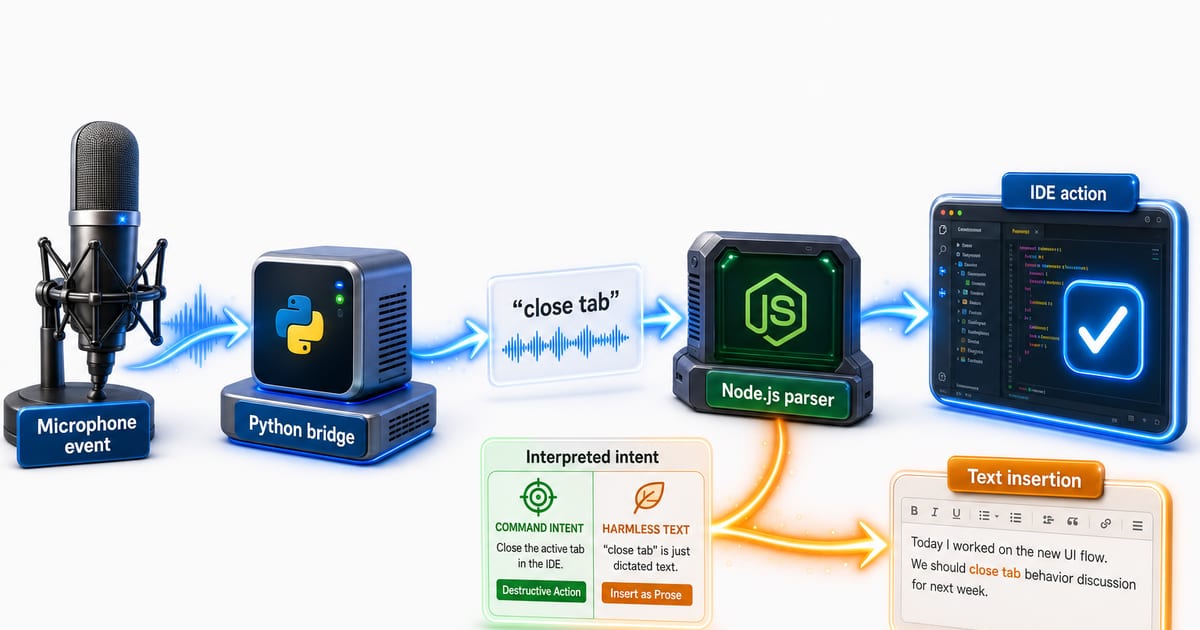
If you dictate into an editor, sometimes you mean to type, sometimes you mean to command, and the app has to tell the difference before it acts.
That is the real problem. A transcript like “close tab” can be harmless prose or a destructive instruction. Treating every spoken phrase as synthetic keystrokes gives the editor a ghost typist with too much confidence.
I built the voice-control path in a desktop IDE as a small compiler pipeline: microphone event, Python bridge process, transcript event, Node.js command parser, then either an IDE action or text insertion.
The split
Python listens and transcribes. Node.js decides. The renderer displays state and inserts text at the chosen destination.
That division is the design. The Python bridge owns audio capture, voice activity detection, transcription, settings, and a line-oriented command protocol. The Electron main process owns Inter-Process Communication (IPC), privileged actions, and the parser that turns a final transcript into an editor operation.
The bridge speaks JavaScript Object Notation (JSON) lines over standard input and standard output. It accepts commands such as start, stop, status, and quit. It emits events such as ready, listening, final transcript, idle, error, and status. That protocol keeps the speech runtime replaceable while keeping workspace mutation inside the Electron side.
The cost is operational shape. A child process has lifecycle, readiness, stderr handling, and environment discovery. I accepted that because the alternative was worse: audio code spread through the renderer, or transcription code gaining accidental access to editor commands.
Silence is a billable input unless it is filtered early
Voice activity detection (VAD) is the first classifier in the path. Silence wastes transcription calls and can still produce accidental text if it reaches speech-to-text, so the bridge checks for speech before sending audio onward.
That choice also keeps failure behavior crisp. When the host has no capture device, the bridge can still start and respond to commands, but the final result is empty. The renderer surfaces that as a “No speech detected” condition instead of quietly pretending dictation succeeded.
The tradeoff is dependency coupling. The bridge has to find and import the existing speech package, including recorder, transcriber, VAD, and settings modules. That is less tidy than a packaged library boundary, but it reuses the proven speech stack rather than cloning it inside the desktop app.
The parser decides between action and text
The main process never treats a final transcript as immediate typing. It passes the string into the command parser.
The current implementation has three practical outcomes:
| Transcript shape | Parser result | Example behavior |
|---|---|---|
| Empty transcript | Reject | Show no-speech feedback, do not edit |
| Exact command phrase | Execute command | Save file, close tab, undo, redo, format |
| Payload command | Execute command with argument | Find text, jump to a line, send terminal input |
| Any other non-empty phrase | Insert text | Dictation lands at the active editor or terminal target |
That table is the intent language. It is small on purpose. Exact phrases get command privileges. Payload commands must have a recognizable verb and argument shape. Everything else becomes content.
This means the implemented no-op path belongs to empty or silent input, not fuzzy ambiguity. I would rather keep that rule visible than pretend the parser has a confidence model it does not have. If a future version adds ambiguous rejection, it should be an explicit parser result, not a side effect of a missed match.
Collision policy is where this pattern earns its keep. “Find” by itself should not become a search without a target. “Find database” can become a command because it has a verb and payload. “Close tab” can execute because it is an exact phrase. “The phrase close tab appears in the docs” inserts as text unless the grammar says otherwise.
That creates maintenance work. Each new command adds another phrase that can collide with normal prose. The parser has to stay conservative: short destructive commands need exact matches, payload commands need argument validation, and ordinary sentences need a predictable insertion path.
The renderer is only the destination
The renderer integration handles status, provisional text while transcription is pending, insertion at the cursor, command display, and terminal forwarding. It knows whether focus is in the editor or terminal. It does not decide whether a transcript is allowed to save a file or close a tab.
The global voice trigger follows the same pattern. The hotkey path routes through the application menu event into the renderer-facing control flow, rather than letting a shortcut handler become a second command executor. The manager still owns start, stop, status, and bridge messaging.
That keeps one chain of custody for spoken input. Audio becomes a transcript. A transcript becomes a parser result. Only then does the desktop IDE apply the effect.
Treat speech like code
The useful model is a compiler. The microphone produces raw input. The bridge turns sound into a token stream. The parser classifies intent. The execution layer applies a constrained result.
Voice input becomes safer when spoken words cross that language boundary before they touch the workspace. The machinery is ordinary: a Python child process, JSON lines, an Electron manager, IPC, and a command parser. The discipline is in refusing to treat speech as typing with a microphone attached.